
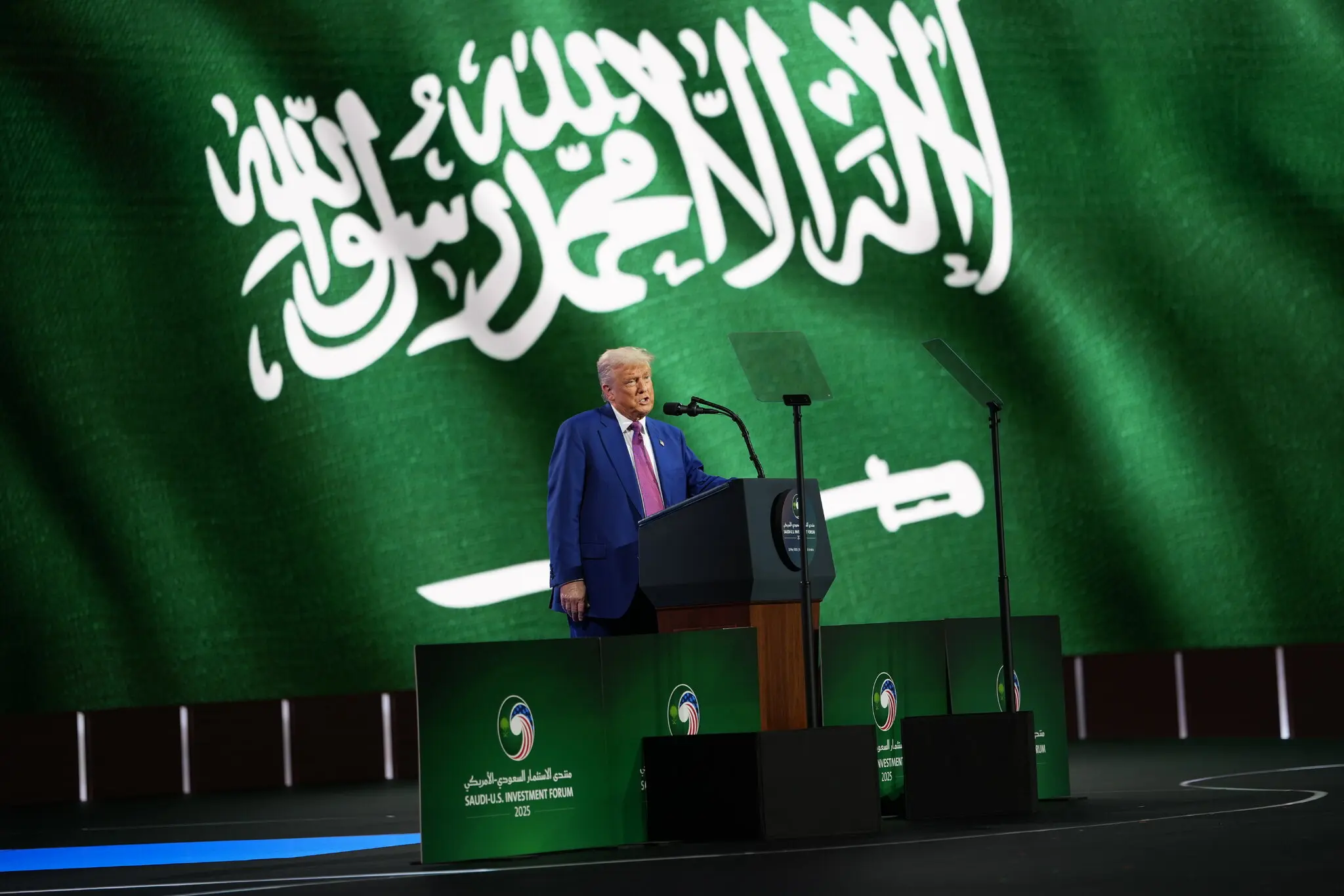
For his first diplomatic tour, instead of visiting the European allies/victims, Trump spent 4 days in the Gulf countries – Saudi Arabia, Qatar, United Arab Emirates. The visit doesn’t appear important at first glance and resembles in many aspects a special Dubai episode of The Apprentice, where Trump spent his time signing contracts with his big black marker, claiming investment amounts making 2 to 3 times the GDP of the concerned countries, being driven in a golf cart by Mohammed Bin Salman and making cringe statements about his love for the Saudi leader (“Mohammed, I like him tooo much”).
But beyond appearances, many things touching on the China-US rivalry, oil market and Palestine took place.
- Trump’s America needs petrodollars
-> First, one must understand that whatever the administration in power, for 10 years or more, the rivalry with China and maintaining capital inflows to the US have been the two main concerns of American presidents.
Both the American stock market and Treasury market have not been doing well since Trump’s arrival. The revelation with Deepseek’s release that China had caught up with the US in the most advanced tech sectors including generative AI (a surprise that isn’t really one if you go to China or don’t listen to Western mainstream media) had already started the decline of the American stock market. This market overvalued in P/E terms only holds by the myth of technological advance surrounding US tech stocks and especially the “magnificent 7” representing 33% of the S&P 500. And this overvaluation only holds because investors from savings surplus countries continue to believe in this myth. The market decline worsened after the chaotic announcement of reciprocal tariffs in April 2nd.
But especially, something unexpected happened in the Treasury market – yields rose sharply while the dollar depreciated, interpreted as a massive foreign capital flight. The US has a structural domestic savings deficit which means capturing foreign savings is necessary to refinance the galloping public debt via Treasuries purchases.
So behind the mind-blowing contracts signed between Gulf countries and Boeing, Nvidia, Starlink etc, two important messages were sent to the markets:
- First, American tech and other advanced sectors notably defense remain the best in the world in their category, proof being these commitments from major international investors
- More behind the scenes, Trump and his Treasury Secretary Bessent had to ensure these countries’ colossal savings surplus would continue going into the Treasury market and there wouldn’t be wild sell-offs in the future.
2. Oil needs to remain low and traded in $USD
Other unpublished exchanges must have concerned oil. One must remember Trump won again in 2024 on the double promise to end inflation linked partly to the explosion of energy costs in 2022 and consolidate US energy supremacy by drilling even more – el famoso “drill baby drill”.
More broadly Trump needs for his grand US reindustrialization plan a low barrel price to increase profitability of industrial projects in the US, but not too low either or the American oil industry goes bankrupt (US unconventional oil is mostly profitable from $65-70 per barrel).
Except that at $70 per barrel Saudi Arabia cannot balance its public budget and thus doesn’t have resources to support the diversification of its economy away from fossil fuels. Trump’s objective was therefore to ensure Saudi Arabia which co-leads OPEC with Russia would push for increased production, thus keeping prices low. This seems acquired for now, since the last OPEC meeting resulted in a decision to increase production even if it makes prices fall.
Very important too but this can’t be said like that, Trump had to ensure Bin Salman would continue selling his oil to the world in dollar-denominated contracts. One must know that oil being dollar-denominated under a 1945 US military protection agreement with the Saudis is the main reason why the dollar is the reserve currency. Indeed if oil and by extension all commodities are priced in dollars, any net energy or metals importing country must accumulate dollar reserves to ensure paying its commodity imports. On this point I won’t go into detail here but since Western sanctions against Russia, many countries especially China have accelerated deployment of their commodity payment platforms other than in dollars.
- Trump wants to reintegrate Iran before it’s too late
Trump gave a speech as usual limited in vocabulary but where some interesting things were said. While covering the Iranian regime with criticism, he opened the door to reconciliation and a deal with Iranians, and more broadly denounced the failure of US interventionist policies in the Middle East officially aiming to install democracy and praised the Arab development model independent from the West. This isn’t the debate here but it’s another sign Trump is a nationalist much more than a universalist imperialist, who accommodates a world shared in influence zones around a few big countries (which doesn’t mean he’s pacifist).
On Iran, many things changed. The US had understood but already under Biden that the regime change policy in Iran through maximum pressure sanctions doesn’t work, and only pushed Iran into the arms of Russia and China. It’s a problem from the US viewpoint that the country with the 2nd largest gas reserves and 4th largest oil reserves sells oil at 20-30% discount to Chinese refineries. Especially the Trump administration fears a conflict involving Iran could push barrel prices beyond $200 (if for example the Strait of Hormuz was closed in retaliation by Iran, or if Saudi oil fields were struck by Iranian missiles).
Another reason for possible détente is the Iran-Saudi rapprochement, which was a diplomatic masterclass Made In China. This too reflects a policy change by Bin Salman, who now cares much more about his country’s economic development than confronting Iran or spreading his version of Islam. Trump takes note and jumps on the bandwagon.
The Israel problem
Israeli press (mostly left-wing and very critical of Netanyahu), reported that Trump has literally ghosted Netanyahu for several weeks. They reported Trump didn’t appreciate at all being perceived as manipulated by Netanyahu and especially, Israeli policy has for some time been increasingly at odds with US interests on two points:
Iran and nukes: Netanyahu built his political capital on the existential threat represented by Iran, an open conflict with Iran being his political goal for 20 years. Israel also opposes any Iranian nuclear program, even civilian. What seems to be emerging is that Trump now seems to propose to Iranians to develop civilian nuclear and end sanctions in exchange for ending Hamas support, banning military-civilian crossover and off-record, detaching from the China-Russia bloc,
Saudi Arabia and nukes: this new Trump deal is supported by Bin Salman, who demands in return access to nuclear technologies to develop his own civilian nuclear program. But Israel always required the US that Saudi Arabia gets nuclear program only with its approval and after recognising the existence of Israel.
Palestinian state: One must add that while Trump probably doesn’t give a damn about Palestinians people, the ongoing massacre in Gaza complicates US administration plans. The quite successful diplomatic achievement of Trump’s first term were the Abraham Accords. These accords had several objectives: allow normalization between Israel and Arab states, generate an explosion of economic links between these countries and long-term, create a grand alliance of all regional states under US sponsorship, thus isolating Iran and its allies. What was to cement this grand alliance is the India-Middle East-Europe Economic Corridor, an infrastructure project of maritime and land routes starting from India, passing through Gulf states and Israel to Europe. The goal of this corridor competing with China’s Silk Roads is to cement a bloc of Arab countries-India-Israel-Europe under US leadership.
Saudi Arabia was the last important Arab state not having signed the accord because the Saudi side was waiting for Israel to give more guarantees regarding recognition of a Palestinian state.
Except that since October 23 2023 events (Hamas attacks), Israel made clear through its actions it will never accept a Palestinian state. More broadly the Palestinian massacre and regional populations’ anger means Saudi Arabia – which hosts Islam’s main holy sites – can no longer afford to normalize ties with Israel.
What could happen next: I see three scenarios from least to most probable:
- Netanyahu yields to pressure, accepts a permanent ceasefire with Hamas allowing hostages’ return and commits with Arab states to build a Palestinian state, enabling completion of Abraham Accords. He also accepts Trump’s plan on Iranian nukes. This is extremely unlikely due to Israeli society’s internal dynamics. One must know that despite Netanyahu’s unpopularity over hostages not being freed, a large majority of Israelis now completely refuse any Palestinian state and demographic dynamism of Israeli society’s most extreme segments (settlers and ultra-orthodox) combined with moderate Jews leaving the country means any elected government would refuse this in the coming years.
- Trump bypasses Netanyahu and a deal is reached on Iranian nukes, but nothing on Palestine. A form of deal is signed allowing Iran to develop only civilian nuclear (and subsequently Saudi Arabia), but Abraham Accords collapse as Israel keeps refusing any Palestinian state. Basically, Israel keeps doing what it wants regarding Palestinian territories but US forbids them from acting against Iran, while Arab states freeze normalization with Israel, denounce the massacre while not doing much to change the situation. This is more or less the current situation.
- Negotiations between Trump and Iran fail for X reasons (especially Israeli influence) and Trump becomes very bellicist toward Iran again. No ceasefire is signed and Gaza massacre and creeping West Bank annexation continue. In this perspective, it’s really not excluded that long-term but probably not under Trump’s mandate, a war erupts between Iran and Israel with Arab states potentially staying neutral. Of course it’s the worst scenario but sadly not the least probable.