
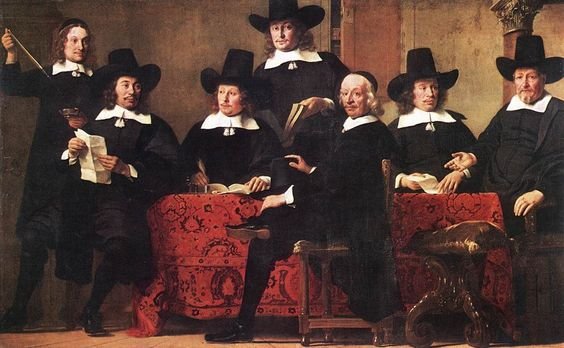
Picture above: portrait of a Dutch Merchant Guild. The golden age of famous Dutch Painting (Rubbens, Vermeer) occurs during the peak of the Dutch Empire.
A quick summary
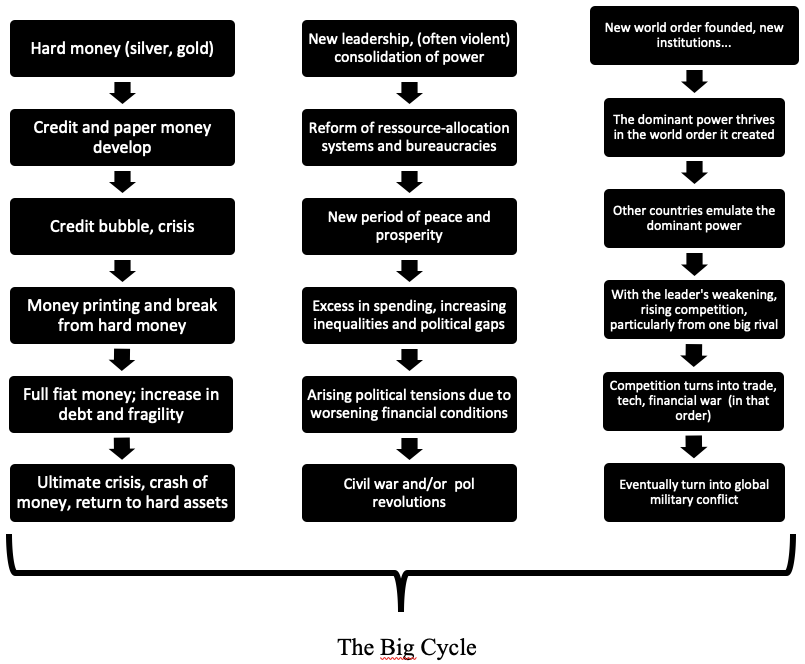
To sum up quickly the last articles, the Big Cycle is the pattern built by Ray Dalio to break down every nation or empire’s evolution from rise to stagnation and decline. The Big Cycle itself is the product of three cycles that are closely related each other and that evolute jointly following the evolution of the eight factors driving wealth and power (see article 1). Here a summary of these three cycles’ stages, knowing the Long-term Debt cycle is the most important one and fully described in my previous article.
Ray Dalio claims its analytical pattern follows four properties, which it demonstrates:
The Big Cycle applies whatever the historical area and geography.
At a defined year, countries are rarely at the same stage of their Big cycle. For example at the edge of World War I, n°1 world power United Kingdom was at his early decline (between stage 4 and 5) while its rising competitor the German Empire was standing between the stage 2 and 3.
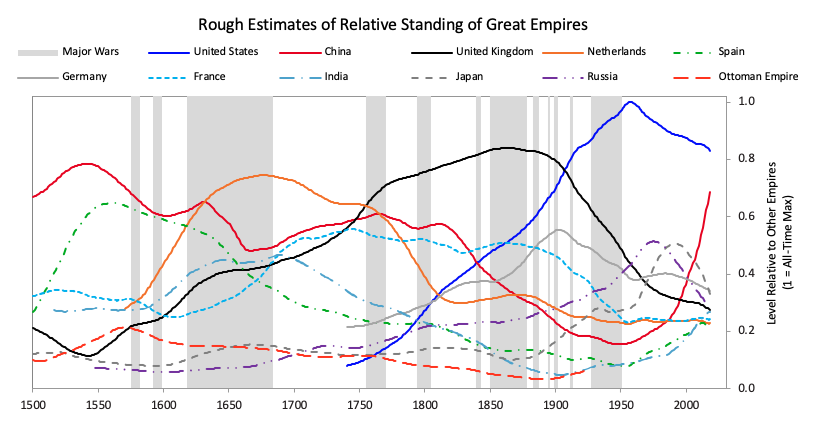
The position of a country in its Big Cycle depends on the weighted average of the 8 factors of wealth and power seen in the article one. Hence, Ray Dalio is able to give any country’s relative index of wealth and power at any moment in History, which is shown by the graph below, for the top ten 11 political entities that have always been relatively powerful over the past 500 years.
The Big Cycle is limited by a) the lack of economic data and historical archives, which prevents from building a country’s wealth and power standing at every area and b) the relative irrelevance of the Big Cycle for pre-capitalist and solely feudal systems. Because lending with an interest rate was banned in Christian and Islamic worlds until up to 1350, and because capitalism was coined by Dutch Kingdom in the 1600s Ray Dalio chooses to focus its analysis over the past 500 years.
The Dutch and English Empires
Ray Dalio gives a detailed evolution of world powers starting 1500 because at that time emerge truly Global and Capitalist powers, i.e countries a) whose financial and military influence stretch across the Earth and not just in their respective continent, b) countries that organize a kind of globalization of trade, financial flows etc and c) countries that develop effective capitalist systems with a world reserve currency.
The two first of these Global and Capitalist powers were the Dutch Empire (1581-1795) and the British Empire (1660-1945)
The Dutch Empire
From 1581 to 1625, the Dutch Empire rose as the dominant superpower. It got independence from Habsburg-ruled Spanish Empire in 1581 then set effective institutions (decentralized republic, first organized equity capital markets, good universities…), which coupled with the Protestant-inherited values (saving, education, hard-work and merit) resulted in rising income and GDP as well as innovations, notably ships that supported long-distance travel.
At the Empire’s peak in 1650, with a population of just 1-2ml people, The Dutch Empire had the world’s most important financial center (Amsterdam), Dutch literacy rates was 2x above the world average, Dutch average income was 2x over most Europe and the Dutch was the world first merchant and military navy, thanks to the Dutch East India Company. This world first publicly listed company was a mix between a global bank and a mega-shipping company. The Dutch Guilder was the world currency. As all merchants wishing to trade with the Dutch had to open an account at the Central Bank of Amsterdam, 40% of world trade was settled using bank guilders.
The Dutch became industrially less competitive than British people and experienced several financial bubbles’ bursts (the famous Magnolia flower bubble) and continuous wars starting 1672 that forced them to print money and increase the debt/GDP ratio. From 1672 to 1784, the Dutch fought three times against England and one time against France. By 1750, France and England were already way more powerful economically and technologically speaking but as always, financial power disappears the last. The Bank of Amsterdam broke link with the gold & silver standard only in 1780, going on a massive printing of money to help the Dutch East India Company and financing war against Britain. An ultimate bank-run on the Dutch’s banking system led to a total collapse of the guilder in 1784 and the take of Netherlands by the French in 1795.
The British Empire
During the Dutch Empire’s peak and decline, England then the British Empire experienced a rapid rise. The bloody English Civil War (1642-1651) and the English glorious Revolution (1688) set the foundations of a political system protecting the rule of law and balance of powers. A modernized banking and fiscal system was implemented, giving inventors the opportunity to fund their projects and the state to financially sponsor them. The legacy of “Enlightenment” was the creation of an elite accepting open debate, new ideas and science. Coupled with England’s coal reserves, it resulted in the First Industrial Revolution, centered around the steam engine technology, invented in England.
England’s technological advance, powerful navy and resource-rich first colonial empire continuously progressed from 1700 to 1850. At the same time it defeated serious competitors: China’s Qing Empire was submitted through the Opium wars and unfair trade treaties, France was neutralized during the Seven Year war and the Napoleonic Wars (1802-1815) and the Dutch Empire was finally defeated in 1784.
All of this led to a peak of Britain’s power and wealth in 1850. 50% of Trade was denominated in pounds, London was the first trading and financial hub, and Britain’s share of world production and global exports were respectively 20% and 40%.
Even thought Britain’s empire and financial influence kept expanding until 1914, it faced starting 1870 until 1945 a) declining competitiveness compared to the US and Germany and b) rising inequality and social conflicts. But as always, Britain’s financial power and reserve currency status disappeared very late in the cycle. Therefore, Britain was able to fund the costly WWI and WWII against Germany while being already overtaken economically speaking. Ultimately, the currency devaluated by 30% against the dollar in 1949 and in 1967, putting a definitive end to the reserve currency’s status.
Interesting similarities can be observed throughout these two Big Cycles:
- There can be a long period between the collapse of a nation’s main factors (education, competitiveness, economic income, share of world’s export) and the end of its last power, the financial and monetary power.
- When ultimately the Empire’s currency loses its reserve status and/or experience an new fnancial crisis it cannot resolve by bailing out the system, the Empire collapses very quickly. Every nation or empire’s collapse is at first very gradual then accelerates tragically.
-There has always been war for the shift from one new world order to another, but often, the dominant power emerging from the war is not necessarily the one who successfully fought the declining main power. The UK-USA rivalry is a case in point. Before Germany’s and communism’s ascension, British elites viewed the US as their most serious rival. But it is another competitor – Germany – that UK had ultimately to fight.
Leave a Reply