

Picture: NVIDIA Headquarters, Santa Clara (California). NVIDIA’s stock price surge over the past 18 months is notably due to this company leading market share in the design of chips for AI technologies, notably Chat GPT.
Who is Kai-Fu-Lee
Kai-Fu-Lee is a prominent computer scientist and investor, born in Taiwan but currently living and working in China. After completing a PhD in computer science at Carnegie Mellon University, where he notably co-developed the first algorithm beating the Othello Human world champion, he occupied several strategic positions in leading US tech firms, such as Microsoft and Apple. In 2005, he is hired as Director of Google China and in 2009, he founded Sinovation Ventures, a venture capital fund investing in Chinese high-tech companies, with assets under management estimated at $3bn as of 2022.
In 2018, he writes AI Superpowers: China, Silicon Valley, and the New World Order, in which he analyses the latest and future developments of AI and their geopolitical and socio-economic fallout.
This book really stroke my attention, because its author is one fo the few experts who has a step in the two leading AI ecosystems: The United States and China. This is essay i am about to introduce and sum up now. The Personal notes (PN) are not included in the book but added to link the book’s content to recent news or further explain some notions.

What is AI ? Definition and evolutions
Kai Fu Lee in its very first chapters traces back the development of AI technologies to the 1960s. At this time, the two biggest methods for developing AI already exist. Neural networks which consists in creating AI by reproducing digital neuronal layers using the structure of human brain opposes to the method of expert systems, which, using human experts’ knowledge in a specific field, encodes in the algorithm a series of rules (if X then Y) enabling it to deal with problems specific to that field. The second technique prevailed for a long time and was even behind the feat of the IBM’s DEEP BLUE computer, which beat Kasparov at chess in 1997. But this type of learning makes AI logically difficult to modulate, as it is specifically trained for restricted use.
To understand the difference between these two methods, let’s take the example of a common application of AI technology: image recognition applied in healthcare. An AI system is asked to help doctors in detecting brain tumors. An expert system AI would detect a brain tumor if the scan of the patient’s brain shows a set of visual conditions predefined, input in the algorithm. Meanwhile, a neural networks AI who was previously fed with millions of images of brain scans deduces by itself the set of correlations and features that relates to the visual representation of a brain tumor.
Neural-based systems are more promising for replicating human intelligence in the body of a machine, but their effectiveness depends on the amount of data available and the computing power underpinning the computer. Also for that reason, the potential of deep learning has long been underexploited, slowing down the general progress of AI technologies.
PN: Artificial intelligence (AI) essentially refers to computing technologies that are inspired by the ways people use their brains and nervous systems to reason and make decisions. At the core of the concept of AI lies the idea of reproducing 100% digitally human intelligence and then overtaking its cognitive abilities for solving problems human mind cannot.
Neural network technique described above is what we call today Deep learning, but it is only a subset of a greater type of Artificial Intelligence, Machine Learning. The book is focused on Deep learning, because artificial neural networks are the key technology in AI industry recent expansion.
The situation has changed over the past 30 years. The NTIC (new technologies of information and communication) revolution has dramatically increased the amount of data available in every field, while the Moore’s Law verification until today (the observation that the number of transistors in an integrated circuit (IC) contained in computers doubles about every two years) has constantly expanded the computing power needed for complex forms of AI.
Neural networks came back into the spotlight in 2012, when the team led by British researcher Hinton crushed their rivals in an AI image recognition competition. The researcher was immediately hired by Google, which, like other companies, saw great commercial potential in the field. Indeed, deep learning holds out the promise of using narrow AI to optimize the resolution – through superior artificial cognitive power – of varied and specific domains. As mentioned above, the effectiveness of this technique depends on the quantity of data used to feed the neural network, the power of the computers supporting the algorithm, but also on a limited field of action and a simple, precise objective.
Contrary to what the current buzz around AI might lead us to believe, it’s been a long time we have passed the era of incremental innovation and fundamental research, a field in which the West, and particularly the US with the Silicon Valley, have excelled. The time has come for applied AI, i.e. marginal improvements to current technology for commercial application. Everything new we hear in the media about AI is simply the application of a fundamental discovery – Deep Learning – to new fields, not the discovery of an equivalent or superior technology. We have moved from an age of skills to an age of data, where the availability of data in quantity and quality is the decisive criterion for the performance of an AI algorithm, while the technical genius of engineers and computing power are no longer comparative advantages. It is for this reason that Kai Fu Lee looks at the case of China, which is taking full advantage of this new age.
The Rise of China’s Internet
For the readers to understand his central thesis – China will lead most of the AI race – Kai Fu Lee describes the emergence of the Chinese IT sector, which lays behind the country’s ability to rival the US in AI.
From imitating to differentiation
Despite being absolutely huge, China’s Internet ecosystem is relatively unknown and until recently, deemed in the West to be a copycat of American’s. It was partly true recognises Kai Fu Lee, at least 20 years ago.
Indeed, China’s digital sector in the 1990s and the 2000s was not an exception of the country’s counterfeit stereotype. For example , MIT doctor Charles Zhang founded China’s first engine research, “Sohoo”, which combines the Chinese word for “research” (soo) with the name of Yahoo!, at that time the US’s biggest engine research. Here come the first contrast between Chinese and American tech firms, which is rooted in cultural differences. Kai Fu Lee explains that Chinese companies’ lack of shame in copying what their competitors do is owed to the centuries-old educational practice of copying again and again Chinese characters for learning them. It results in patent laws being looser in China than in the US.
However, starting the mid-2000s, rising Chinese Internet companies started to adapt their services to local customers’ preferences and not just copying the Western content. Kai Fu Lee notes there the second difference between Silicon Valley companies operating abroad and Chinese Tech companies. The first one’s ideal of innovation consists of designing a universal product prior to introducing it to the market while Chinese tech companies prefer a bottom-up approach, i.e listening to customer’s needs to devise and tailor their approach.
As an example, in 2002, Ebay, back then the world’s leading e-commerce site, settles in China and becomes the leader of its market by buying out its Chinese copy. Like everywhere else, Ebay China has decided to adopt a user interface identical to that of Ebay US. The remuneration model also remains similar to that used in the United States, i.e. sellers pay fees to the platform when products are put up for sale, during the transaction and, where applicable, when payment is made.
At the same time, a certain Jack Ma, who founded a competing platform called Alibaba in 1999, decided to move away from the classic imitation of American sites. First, Jack Ma created Taobao, an auction platform in direct competition with eBay. The latter responds to the specific lack of confidence of the Chinese in online purchases by creating the Alipay payment service. Alipay blocks the amount paid by buyers until they confirm receipt of their order. The creation of instant messaging between sellers and buyers on the platform also helps to improve trust. Lastly, Jack Ma was the first to introduce what is known today as the “freemium” model: sellers will not have to pay any fees when creating ads and carrying out transactions on Taobao, for a period of 3 years. Thanks to this, Jack Ma has attracted a large number of small and medium-sized Chinese retailers, followed logically by larger sellers paying for advertising space to increase the visibility of their products. This strategy, which at first sight seemed ruinous, eventually enabled the company to overtake Ebay, which left the market in 2003. All American tech companies experienced a similar fate.
The avent of US big tech’s only rival
2012 marks the latest stage in the development of the Chinese Internet, which is now rivals the American Internet but at the same time radically differs from it. Five factors underpin this differentiation.
-Firstly, in the early 2010s, the Chinese rapidly adopted mobile Web on a massive scale, to the detriment of the computer, which at the time was too expensive for the majority of the population.
-Secondly, the creation of a national super app, WeChat, which before Whatsapp introduced the ability to send videos and photos, groups and above all the possibility for service companies (gaming, media, marketing) to host their content on Wechat rather than creating their own app. WeChat is now an app within an app, where you can do everything from paying, playing games and exchanging messages and photos to ordering a taxi or food.
-Thirdly, the spread of mobile payment, introduced by WeChat Wallet and taken up and massified by Alipay, which already existed before. WeChat Wallet, a service integrated into WeChat, is launching the red envelope operation for New Year’s Eve 2014. Chinese people who traditionally like to give their loved ones these envelopes of cash can now do so online, by connecting their bank account to Wechat wallet and sending money to their friends on this app. Mobile payment is taking root after this event, and QR code payments are becoming even more popular.
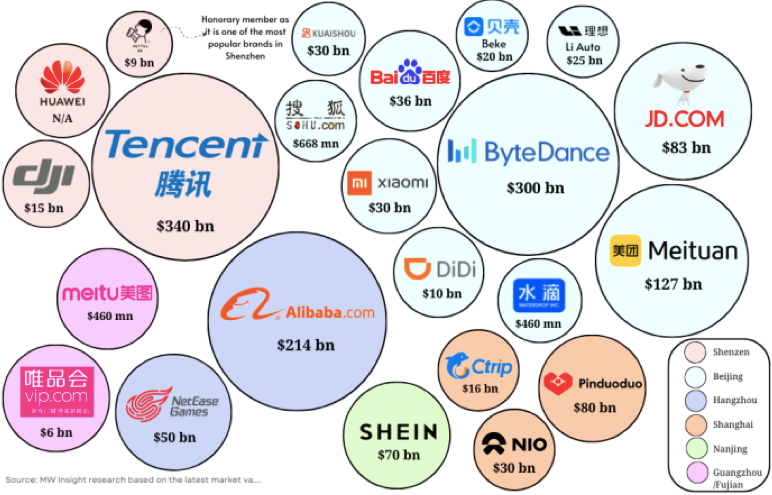
-Finally, the flooding of the market with public subsidies and the insane competitiveness of the Chinese tech sector have led to the creation of behemoths, pictured in the image below. In a sense, China is a curious mix of extreme capitalist competitiveness, strong state intervention and relative decentralisation. The country protects its private companies from foreign competitors, but domestically there are few laws to protect company’s patents. Chinese tech workers typically work a lot, much more than their American counterparts, under the orders of a CEO who will stop at nothing to take market share. Similarly, 85% of public spending is actually carried out by local governments, which are much more in charge of economic development. The policy of guiding funds and emulation between provinces, municipalities and local officials to attract entrepreneurs to their incubation centres (payment of rent, tax reductions) has boosted the financing of innovation in China, despite the certain waste of financial resources.
The two superpowers of AI
Kai-Fu-Lee insists that there are currently and in the coming two decades only two countries mattering when it comes to AI: China and the United States. Europe has missed the wave because it didn’t develop at time domestic tech giants, like most of the world. The very few countries with domestic internet companies are either too small for dominating the AI landscape (South Korea, Russia, Singapore) or they need decades of technological catch up before matching the two giants – basically India.
The United States
The United States is and will continue to be home to some of the best AI researchers on the planet, an asset that will play a key role in the ability to take deep learning to the next level. For example, Alphabet employs half of the top 100 AI researchers, with Microsoft, Meta and Amazon not far behind. The US Big tech are fuelled by a network of smaller start-ups and universities of excellence, most of which are located in Silicon Valley.
The typical Silicon Valley company wants to develop a single, universal product, which it will gradually improve once it is on the market and that intends to revolutionize human society. Digital services using AI will not be lacking in this description.
The ability of the United States to maintain a lead in deep learning and its next stage is linked to the control of electronic chips adapted to deep learning algorithms. Nvidia is a leader in this field.
As an example, in May 2017 , AI Alpha Go won a landslide victory against the Go game’s world champion Ke Jie. Alpha Go has been developed by the Start- up Deep Mind, buy-out by Google
China
This event made the Chinese government and Chinese Internet companies aware of the country’s lag in AI. 2 months later, the government launched a plan to make China the leader in AI by 2030. The following year, for the first time, China accounted for a greater share of global investment in this sector than the United States (48%).
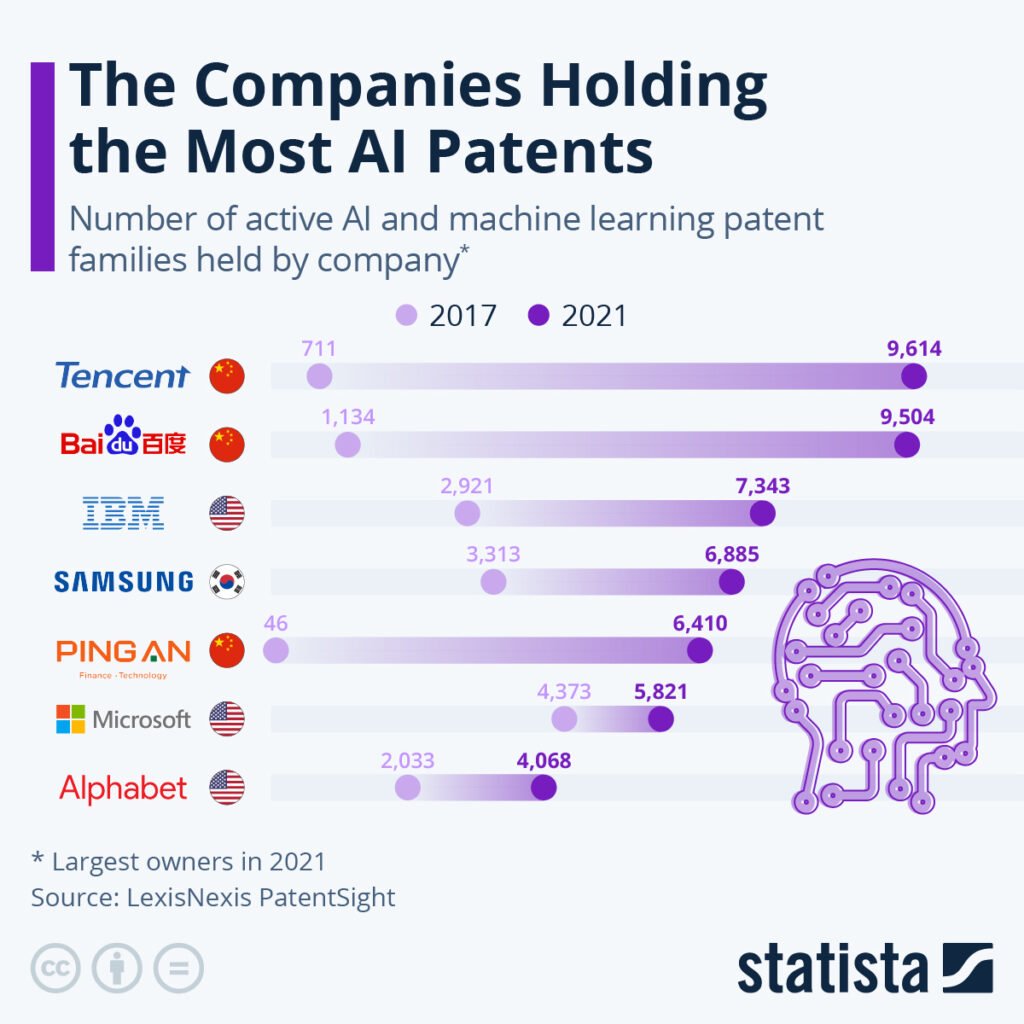
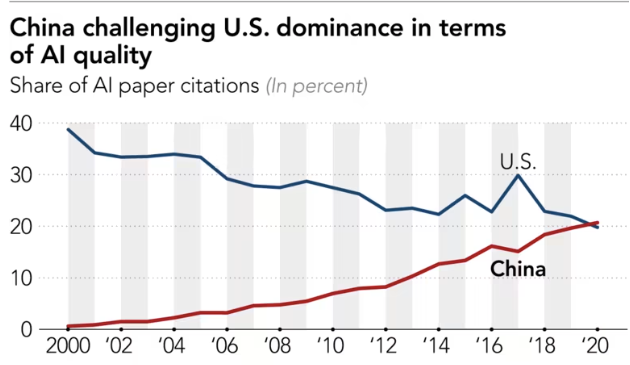
According to Kai Fu Lee, this is due to China’s advantage in applied AI research and the commercial uses of the current generation of AI. Applied research, whether academic (open to the public) or industrial (private), is clearly catching up, as the graph below shows. Baidu is the most advanced Chinese digital company in AI.
The typical Chinese tech entrepreneur runs a lean company. It prefers to launch directly the product with the minimum viable, but constantly changes and adapts based on feedback from users and changes in market trends. This company doesn’t hesitate to copy then innovate in another area.
Chinese companies are also at the forefront of the online to offline or O2O revolution. O2O is similar to what e-commerce companies do with physical goods, but concerns everything that cannot be put in a box and shipped. These are all markets for services ordered and available online but consumed in the real world. We are moving from managing information and communication on a platform (Google, Messenger, Facebook) to taking charge of aspects of everyday life. Uber pioneered this model, but the Chinese have replicated it in a host of other markets, thanks to an existing mobile payment infrastructure that links the digital and real worlds, and above all a steamroller strategy.
VTCs (Didi), food delivery companies (Danping) and property rental companies (Tujia) are much more vertically integrated into the industry, managing costs that sellers or buyers do not want to manage: logistics, distribution, maintenance and payment. These companies rely on the economies of scale associated with the size of Chinese cities and the middle classes’ desire for comfort. The number of migrant workers also helps enormously.
All these features of the Chinese market result in huge amounts of data that gives the country an advantage over the US. Above all, The Chinese political culture differs from the American one. It is much more techno-utilitarian, i.e. support for innovation is more constant and, above all, doesn’t get embarrass for ethical dilemmas as long as AI is seen as bringing benefits to the greatest number of people in the long term and doesn’t threaten the Communist party’s power.
PN: technological advance matters, but the opinion of consumers about the public also. According to a poll conducted by the World Bank, in China and other emerging countries, the share of people thinking AI will bring more advantages than threats is systematically above 50%, while in Western countries where US big tech dominate, this share is systematically lower than 50%.
The second part of my article will be dedicated on the coming four waves of AI and their consequences on growth, employment and social contracts.